Leg Entanglements in Jiu Jitsu: Where to Start, What to Learn, and How to Practice
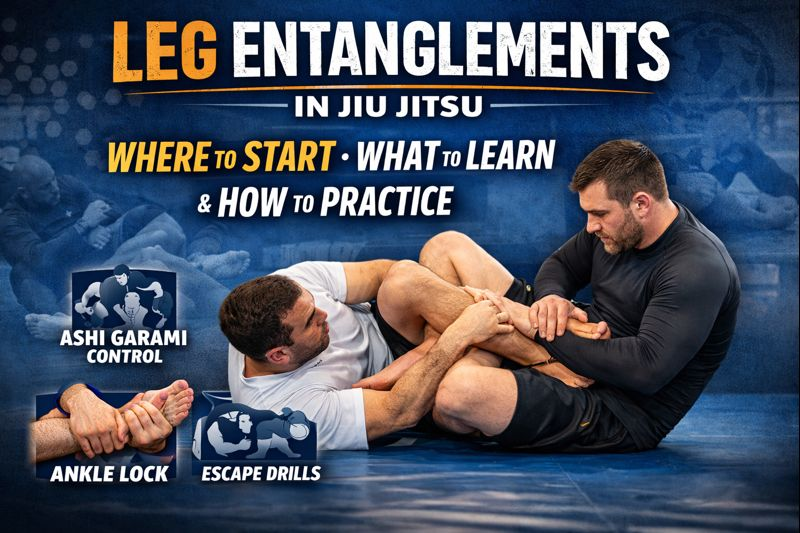
Leg entanglements can feel overwhelming when you first step into that side of jiu jitsu. Between unfamiliar positions, complex names, and the speed at which leg attacks can finish, many grapplers either avoid them completely or dive in without a plan. The truth is, leg entanglements are just another positional system—one that rewards structure, patience, and smart practice.
This guide breaks leg entanglements down into three simple ideas: where to start, what to learn first, and how to practice safely and effectively.
Where to Start With Leg Entanglements
The biggest mistake beginners make is starting with submissions instead of control. Before thinking about heel hooks or ankle locks, you need to understand how to isolate a leg and control distance.
A great starting point is learning Ash Garami (single-leg X). It teaches:
- How to off-balance your opponent
- How to control their hips and knee line
- How leg entanglements connect to sweeps and stand-ups
From there, progress into outside ashi and inside ashi (cross ashi). These positions form the backbone of modern leg-lock systems and appear constantly at every level of competition.
At this stage, your focus should be:
- Keeping your knees tight
- Controlling the opponent’s hips
- Understanding where your feet should be placed for balance and safety
What to Learn First (and What to Avoid Early)
You don’t need to learn every leg lock at once. In fact, trying to do so usually slows progress.
Learn These First
- Straight ankle lock: Legal at most levels and forces you to learn proper breaking mechanics
- Knee line control: If the knee escapes, the position is lost—this concept matters more than the submission
- Basic leg-lock defense: Clearing the knee line, turning the heel, and standing to disengage
Save These for Later
- Spinning entries
- Inverted leg entanglements
- Heel hooks without positional understanding
Leg locks are fast, but the learning process should be slow and controlled.
Understanding Position Before Submission
Think of leg entanglements the same way you think about mount or back control. A submission is a result, not the goal.
Strong leg entanglement players prioritize:
- Hip control over foot control
- Balance over chasing finishes
- Transitions between leg positions instead of forcing one attack
If your opponent defends your ankle lock and turns away, that’s not failure—it’s an opportunity to transition to a sweep, back exposure, or a different leg position.
How to Practice Leg Entanglements Safely and Effectively
Because leg locks can be dangerous when applied carelessly, how you train them matters.
Drilling
- Start with static positional drills
- Focus on entries and transitions, not finishing speed
- Drill both attacking and escaping the position
Positional Sparring
- Start in Ashi or 50/50
- Set rules like “no heel hooks” or “catch and release”
- Reset once the knee line escapes or a sweep occurs
Live Rolling
- Communicate with your training partner
- Apply submissions slowly and with control
- Tap early and often when defending
A good leg-lock room isn’t reckless—it’s technical.
Integrating Leg Entanglements Into Your Overall Game
Leg entanglements shouldn’t replace your existing game—they should support it.
They pair well with:
- Guard retention
- Wrestling-up from seated guard
- Passing reactions when opponents stand
Even if you never become a leg-lock specialist, understanding leg entanglements will make you harder to pass, harder to sweep, and far more difficult to submit.
Final Thoughts
Leg entanglements aren’t magic, and they’re not shortcuts. They’re a positional system that rewards grapplers who approach them with structure, humility, and patience.
Start with control. Learn a few positions deeply. Practice with intention. Over time, leg entanglements will feel just as natural as passing guard or finishing from the back.
That’s the real goal—not collecting submissions, but building understanding.
Related Post
Should You Use Instructionals to Supplement Your BJJ Training?
Brazilian Jiu-Jitsu has never been more accessible. Between daily classes, open mats, competition footage, and [...]
Mastering the Closed Guard: Sweeps, Attacks, and Why It’s Essential
In Brazilian Jiu Jitsu, the closed guard is one of the first positions students learn [...]