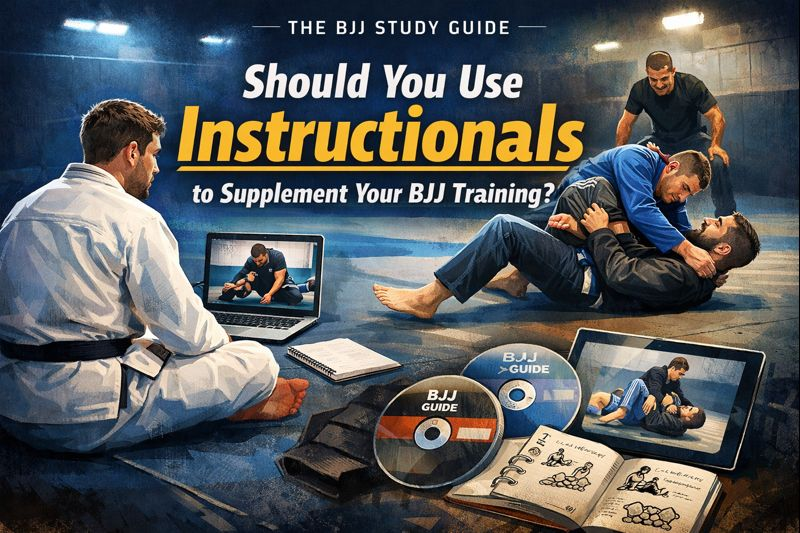
Should You Use Instructionals to Supplement Your BJJ Training?
Brazilian Jiu-Jitsu has never been more accessible. Between daily classes, open mats, competition footage, and an endless supply of online instructionals, today’s grappler has more learning tools than any generation before. But with that abundance comes an important question:
Should you be using instructionals to supplement your BJJ training—or are they just a distraction?
The short answer: yes, instructionals can be extremely valuable—if they’re used correctly. The long answer requires understanding how instructionals fit into real training, where they shine, and where they can actually slow your progress.
Let’s break it down.
What Are BJJ Instructionals Really Good For?
Instructionals aren’t a replacement for live training, coaching, or mat time. What they are is a way to organize knowledge, fill gaps, and accelerate understanding.
1. Structured Learning That Classes Can’t Always Provide
Most BJJ classes are designed for groups, not individuals. That means:
- Techniques rotate weekly
- Skill levels vary
- Concepts may be introduced without deep follow-up
Instructionals solve this by offering:
- Step-by-step systems
- Clear progressions
- Context for why techniques work, not just how
If you’ve ever felt like you’re collecting random moves without a roadmap, instructionals can give you that structure.
2. Deep Dives Into Positions You Care About
In class, you might spend:
- 10 minutes on half guard one week
- 10 minutes on leg entries the next
- 10 minutes on passing after that
Instructionals allow you to:
- Spend hours on one position
- Learn entries, counters, and transitions
- Understand common reactions and mistakes
This is especially useful if you’re:
- Building a game around a specific guard
- Preparing for competition
- Trying to fix a weak area in your grappling
3. Learning at Your Own Pace
Not everyone learns best in a fast-paced class environment. Instructionals allow you to:
- Pause and rewind
- Rewatch key details
- Take notes and test ideas over time
For visual learners or analytical grapplers, this can be a massive advantage.
Where Instructionals Can Go Wrong
Despite their benefits, instructionals can hurt your progress if misused.
1. Consuming More Than You Apply
One of the biggest traps is watching without drilling.
If you:
- Watch five instructionals
- Try everything at once
- Never focus on one concept long enough
You’ll end up with surface-level knowledge and inconsistent execution.
Rule of thumb:
👉 One instructional, one position, one focus at a time.
2. Technique Hoarding Instead of Skill Building
Instructionals can make it feel like improvement comes from learning more techniques. In reality, improvement comes from:
- Timing
- Repetition
- Understanding reactions
- Pressure and balance
If instructionals aren’t paired with:
- Positional sparring
- Intentional drilling
- Live experimentation
They remain theoretical—and BJJ is not a theoretical art.
3. Ignoring Your Coach’s System
Not every instructional fits every academy’s style. Blindly following outside material can sometimes:
- Conflict with your coach’s philosophy
- Create confusion in training
- Lead to inconsistent decision-making
The best approach is to use instructionals to support, not override, what you’re learning in the room.
How to Use Instructionals the Right Way
If you want instructionals to actually improve your Jiu-Jitsu, use them with intention.
Step 1: Identify a Specific Problem
Ask yourself:
- “What position am I losing from?”
- “Where do I stall?”
- “What keeps coming up in rolls?”
Choose an instructional that solves that problem.
Step 2: Limit Your Focus
Instead of trying to absorb everything:
- Pick 1–2 techniques or concepts
- Test them for several weeks
- Track what works and what doesn’t
Depth beats variety.
Step 3: Bring It to the Mats Immediately
After watching:
- Drill it in class
- Ask training partners for specific looks
- Start from that position during rolls
The faster you apply it, the faster it becomes real.
Step 4: Evaluate and Adjust
Instructionals don’t replace feedback. Pay attention to:
- What fails under resistance
- Where you get stuck
- How higher belts respond
Then revisit the material with better questions and context.
Are Instructionals Better for Certain Belt Levels?
White belts:
Instructionals can help—but fundamentals and live training should come first. Focus on concepts, not flashy techniques.
Blue & Purple belts:
This is where instructionals shine. You have enough experience to filter information and apply systems intelligently.
Brown & Black belts:
Instructionals become refinement tools—helping sharpen details, transitions, and edge cases.
Final Thoughts: Are Instructionals Worth It?
Instructionals are one of the most powerful learning tools in modern Brazilian Jiu-Jitsu—but only when used intentionally.
They work best when they:
- Supplement consistent training
- Reinforce your coach’s teaching
- Focus on solving real problems
- Are paired with mat time and feedback
Watch less. Apply more. Train with purpose.
That’s how instructionals stop being entertainment and start becoming progress.
Related Post